Report authored by United Academics AFT-AAUP Local 3209’s Communications & Action Team
Amidst devastating cuts across higher ed, our faculty union at the University of Oregon saw a victory in averting a summertime plan by our administration to eliminate ~25 tenure-track faculty and ~10 degree programs. Inspired by Rutgers’ “wall-to-wall” union model, we fought to prevent any layoffs or program closures, and rejected the administration’s attempts to exploit divisions among workers along occupational categories, rank, and academic disciplines. The campaign taught many of our rank-and-file union members important lessons:
WE are the union! WE must build power to democratize our university!
We pursued three major strategies, with rank-and-filers leading much of the effort:
- Legal actions — filing multiple grievances, preparing possible ULPs, pursuing expedited arbitration, demanding to bargain the impacts of every layoff;
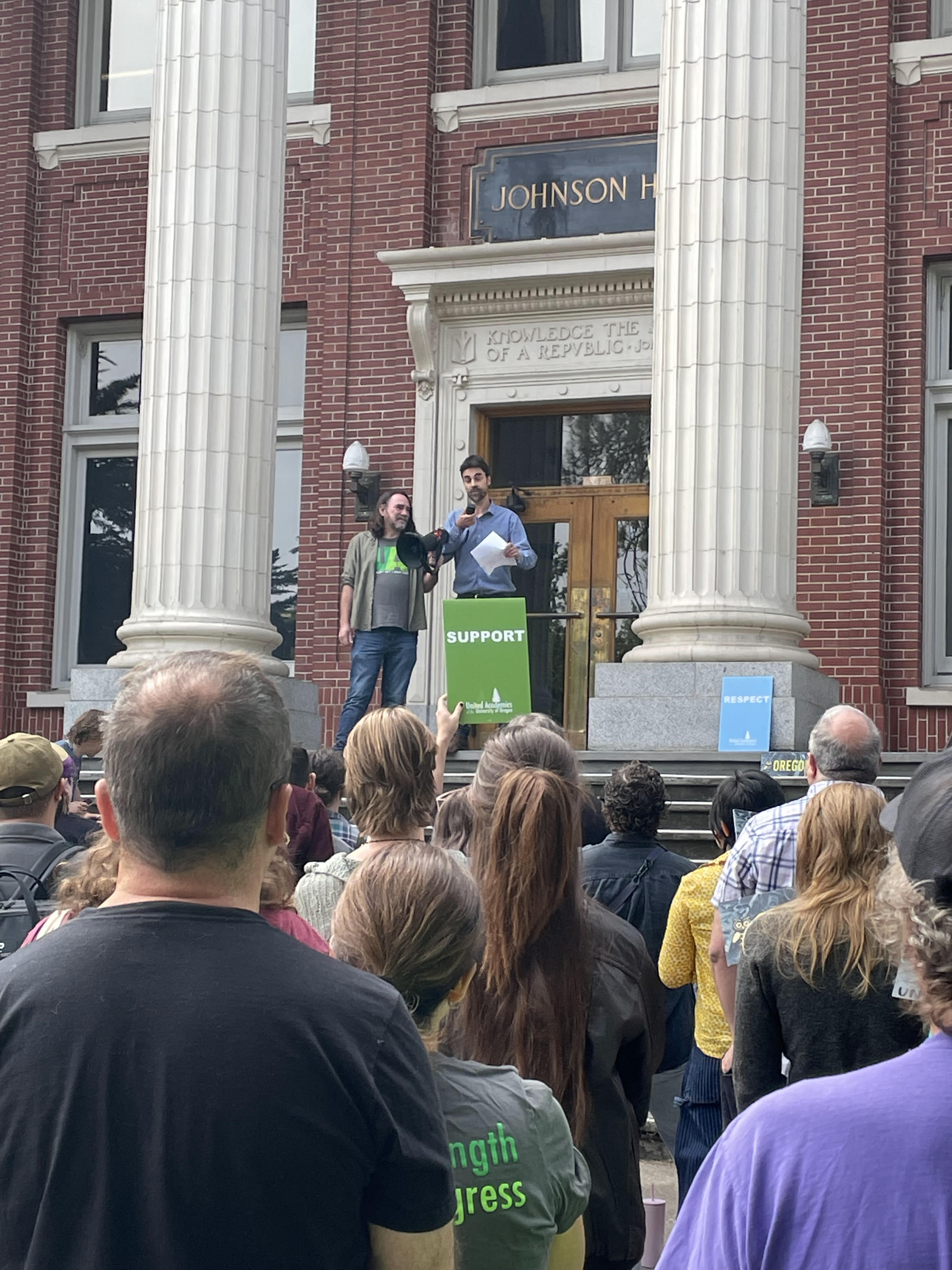
- Collective action — coordinating with the University Senate, student government, and all four campus labor unions through the UO Campus Labor Council (UA AFT-AAUP 3209, GTFF-AFT 3544, SEIU 503, UOSW-UAW 8121) to send UO leaders 1,000+ auto-filled letters, gather ~3,000 signatures on an anti-cuts petition, and hold an in-person rally that turned out ~100 mostly off-contract workers;
- Public pressure — joint statements by the University Senate, UO student government, and faculty groups; meetings with a dozen local, state, and national elected officials, several of whom sent a public support statement to UO leaders; support statements from the President of the AAUP, distinguished UO alumni, UO donors, academic associations/networks; press coverage (~30 local to international media spots); a social media and web campaign.
These actions put pressure on UO upper administration and Board of Trustees, including through a credible threat of a no-confidence vote from the UO Senate. The result was UO President Scholz’s September 8 volte-face announcement that no programs would be closed and no tenure-track faculty laid off. Scholz did announce 61 new layoffs, adding to 56 from earlier in the year. However, the numbers of September layoffs for both faculty (5 NTTF) and classified staff (21) were fewer than union leaders had expected, with faculty cuts hitting hardest in the Libraries (3 NTTF). Non-unionized Officers of (lower) Administration saw 35 layoffs. Unionized UO Student Workers report non-reappointment or elimination of ~100 positions. Scholz has also signaled that future graduate employment funding will be limited or eliminated in some areas. All of this, while no upper admin roles were cut or saw even minimal salary reductions.
Despite these losses, our campaign united UO faculty, staff, students, alumni, and allies in the fight for democratization, shared governance, and financial transparency and against top-down decision-making, austerity, and creeping authoritarianism.
In particular, upper administration’s insistence upon “confidentiality” was a means to consolidate power and prevent democratic shared governance. In mid-August, for instance, College Arts and Sciences Dean Chris Poulsen informed several Humanities department heads that their programs would be eliminated or severely reduced with all or most of their tenure-related faculty terminated. Heads were essentially sworn to secrecy. Despite fear of retaliation, some were courageous enough to alert other faculty members anyways, which enabled us to fight back. Similarly, we resisted the misuse of a “confidential,” unelected ad-hoc Senate committee as a backdoor to avoid consultation with our full Senate. Publicly, UO leaders claimed to engage in proper collaboration with faculty, further pointing to “transparency” through avenues like mass emails, a website, meetings with Deans and Heads, and a one-time Town Hall with pre-selected questions. At an emergency “open” Senate meeting on August 29, our coalition asserted that UO leaders had not met their legally required obligations to consult with workers and the Senate. By September 8, our pressure campaign paid off.
But we are not done. Over 30 campus members spoke out at the September 16 UO Board of Trustees public comments session, demanding Trustees to delay a budget vote in favor of a continuing resolution. Despite all that testimony, the UO Board of Trustees unanimously approved the new austerity budget in a matter of minutes, after Board Chair Steve Holwerda parroted Provost Long’s talking point that too much transparency had in fact been the real issue: “the more you share, the more fear is created.”
We now organize even more vigorously for the goals that all 4 campus labor unions and the student government outlined in our shared resolution (June 2025):
- Ensuring accountability – including organizing, as a last resort, a no-confidence vote;
- Implementing democratic, participatory governance through the UO Senate, campus unions, and other democratically elected bodies;
- Making UO’s finances more transparent, its budget model more realistic;
- Restructuring UO’s finances to prioritize the true mission of our university: not sports franchising, capital construction, or private donor priorities, but public education and research.
We call upon our allies across the national higher ed labor movement to join us in this struggle. Universities work because we do. We all deserve a seat at the table in shaping a more democratic and sustainable higher education system!