
by Payam Barghi, Interim Vice President and Chief Negotiator of Gavilan Student Workers Union (GSWU)
Gilroy, California calls itself the “Garlic Capital of the World” and sits just thirty miles south of Silicon Valley. Close enough to be a commuter town for Bay Area workers, but just far enough to still be a farm town. Drive a little further to Hollister, and agriculture has a stronghold on the town’s economy – the same fields where United Farm Workers organized strikes and boycotts, teaching the next generation the importance of collective action. These two towns are where Gavilan College campuses sit and have many community members whose families grew up working in the fields and packing plants.
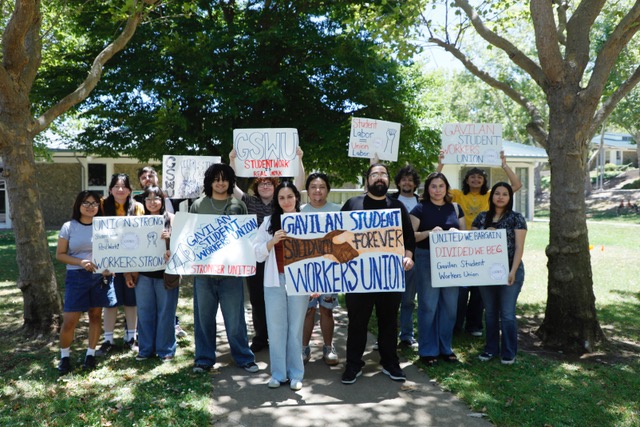
Today, Gavilan College is preparing the next generation of workers academically – and professionally through student employment. Being a student worker, I feel so fulfilled helping our community members accomplish their goals. I quickly realized how important our role is on campus. Not only are we the community being served on campus – but we serve that very community too. We speak the same language, we have similar backgrounds, and we understand our mutual struggle – because we are living it alongside the students we help. As a peer tutor in the Writing and Tutoring Center, I take pride in being able to play a role in developing fellow students in becoming the writers they were meant to be. Switching between student and worker, sometimes in the same hour, between a class and a shift is daily life for us.
In my first weeks as a student worker, I heard the same concerning messages from my colleagues, over and over. “I can’t afford the food in the cafeteria.” “I can’t work my shift tomorrow because I’m picking up an extra shift at my second job — it pays more.” “I’m worried I won’t get enough hours to keep working here.” At the time, student workers started at minimum wage and could earn only up to two dollars more per hour, depending on specific training and years worked — still below California’s fast food minimum wage of $20 per hour, and bound by the district’s strict 20-hour workweek limit.
As conversation continued with workers, I knew something had to be done. I saw that the CSU student workers had unionized across the state earlier that year – and they had similar issues with their work conditions. Student labor is often an afterthought for decision-makers at academic institutions, regardless of how important our role is on campus. It became clear that the issues student workers deal with are systemic, and so our response had to be as well.
Student labor is often an afterthought for decision-makers at academic institutions, regardless of how important our role is on campus. It became clear that the issues student workers deal with are systemic, and so our response had to be as well.
– Payam Barghi
I led efforts to form an organizing committee that could give diverse perspectives from different departments on the two campuses. This was essential to truly understanding student workers’ day-to-day struggles and how to advocate for workers’ needs. Our committee was able to inspire a shared vision – a vision that included student workers with a seat at the table to advocate for our evolving needs. We knew that there weren’t any examples of unionized student workers at the community college level, but that never gave us any pause. As student workers at a community college, we see nearly 50% turnover year-over-year. In a culture that expects instant results, we know that some of us may never see the impact the union makes – but those workers feel a great deal of pride in having been part of systemic change. Turnover was and is a major hurdle for us, but our passion and strategic approach to making the most of every day were imperative to winning the union.
Through GSWU’s efforts, we have already guaranteed a 17% raise for student worker wages across the board. We’ve secured free student parking for all our workers. We have shown that it is possible to advocate for better conditions and secure meaningful wins. Not only do we carry with us the lessons learned in the context of our student worker positions, but also improve our knowledge on workers’ rights. This isn’t incidental. It’s something we set out to build on purpose. Thirty miles north, Silicon Valley has spent the year laying off thousands of workers with no union and no real say in their working conditions. Some of our members, not unlike many student workers across higher education, are heading into that same industry next. The difference is, they know what union membership feels like and know what’s missing if it isn’t there. A union job as your first job means workers’ rights stop being something you read about and become something you’ve practiced.
We believe that’s worth fighting for – especially right now.
Student Work is Real Work!
A union job as your first job means workers’ rights stop being something you read about and become something you’ve practiced. We believe that’s worth fighting for – especially right now.
– Payam Barghi