
By Tracy Berger, HELU Communications Coordinator and member of United Campus Workers Colorado
At MIT, an alliance between property service workers and graduate students shows the power of wall-to-wall organizing for living wages and workers’ rights against a shared, well-resourced management.
On October 23, workers with SEIU Local 32BJ will bargain for the first time in over a month with Massachusetts Institute of Technology (MIT) administration. SEIU Local 32BJ represents a large number of blue-collar property service workers (such as electricians, custodians, groundskeepers, and others) spread up and down the East Coast. Its members work in a variety of sectors, including at many higher education institutions. Also bargaining with MIT this Friday is the Graduate Student Union (UE Local 256 – MIT GSU). Members of these two unions are standing together as they negotiate better working conditions.
Both MIT GSU and 32BJ have strike authorization votes on the horizon. MIT GSU started voting on October 19 and 32BJ will begin voting on October 27. They’ve pledged to coordinate with one another, aware that together they wield more power than each unit could alone. Together they represent a huge swath of MIT’s workers – including some of the lowest-paid workers who hold much of the responsibility for making MIT run.
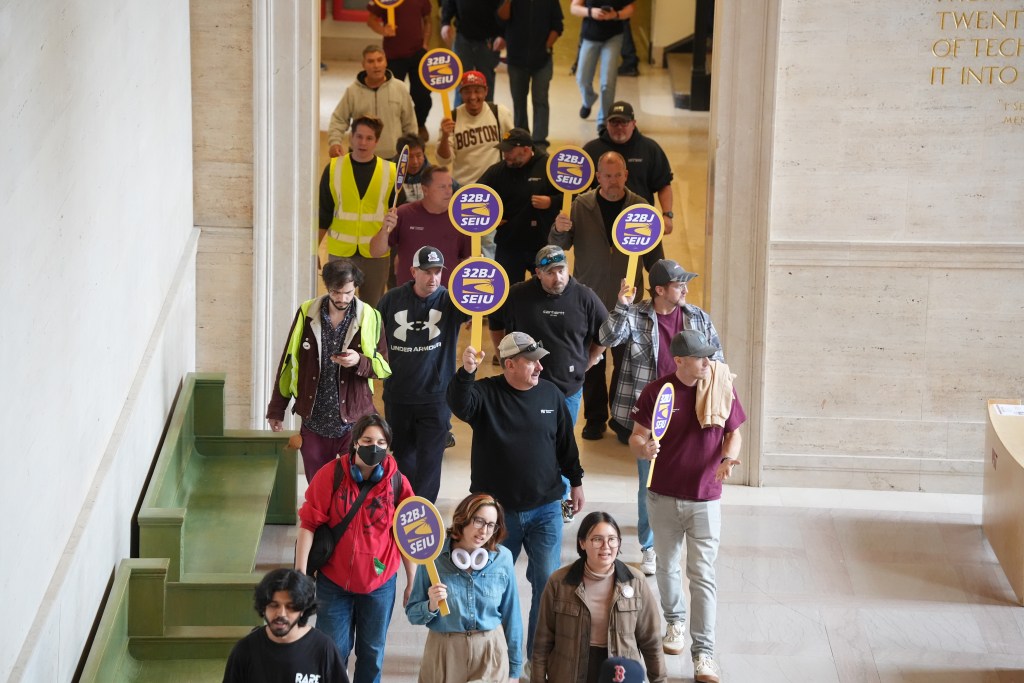
At many campuses a vast divide exists between blue-collar and graduate worker unions – and they didn’t always work together at MIT like they do now. By building relationships and organizing together, solidarity has grown.
More in common than we might think
It was the end of 2025 when MIT GSU and 32BJ members started collaborating. It quickly became clear they were aligned: the administration was not bargaining seriously with either of them even though MIT could afford to pay all their workers a living wage. Additionally, they realized the two units’ bargaining timelines were just one month apart.
Both unions are stuck on similar core issues in bargaining: wages, understaffing, healthcare costs, international worker protections, and more. MIT GSU and 32BJ members often work multiple jobs to make ends meet. Members from both unions have left MIT because they couldn’t afford to continue working there or weren’t sure their positions would be funded in the future. For grad students, that often means not finishing out degrees.
Since the beginning of 2025, MIT has been making big budget cuts that largely impact workers, as they prepare to lose federal funds. When people retire or leave for other opportunities, their positions don’t get filled. New buildings – such as W41 – still open, but no additional custodial staff are hired. According to workers in these departments, there are more than 20 positions vacant in Custodial Services, 16 unhired positions in HVAC, 4 unfilled electrician roles, and more among campus sprinkler fitters. Workers are spread thinner and thinner.
“Everybody’s short-staffed, everybody’s doubled up with their workload,” said Maria Petrosillo, a foreman on the nightshift in Custodial Services and member of 32BJ’s bargaining team.
“We’re bearing the brunt. Maria’s crew, my crew, we’re bearing the brunt of it. We’re working overtime, and we also have families and other responsibilities to tend to. We didn’t sign up to live there. These members care enough and are willing to make sure shifts are filled and the campus is covered for the students, researchers, staff, and faculty,” said Jim Bradford, 32BJ Chief Steward and MIT Electrician.
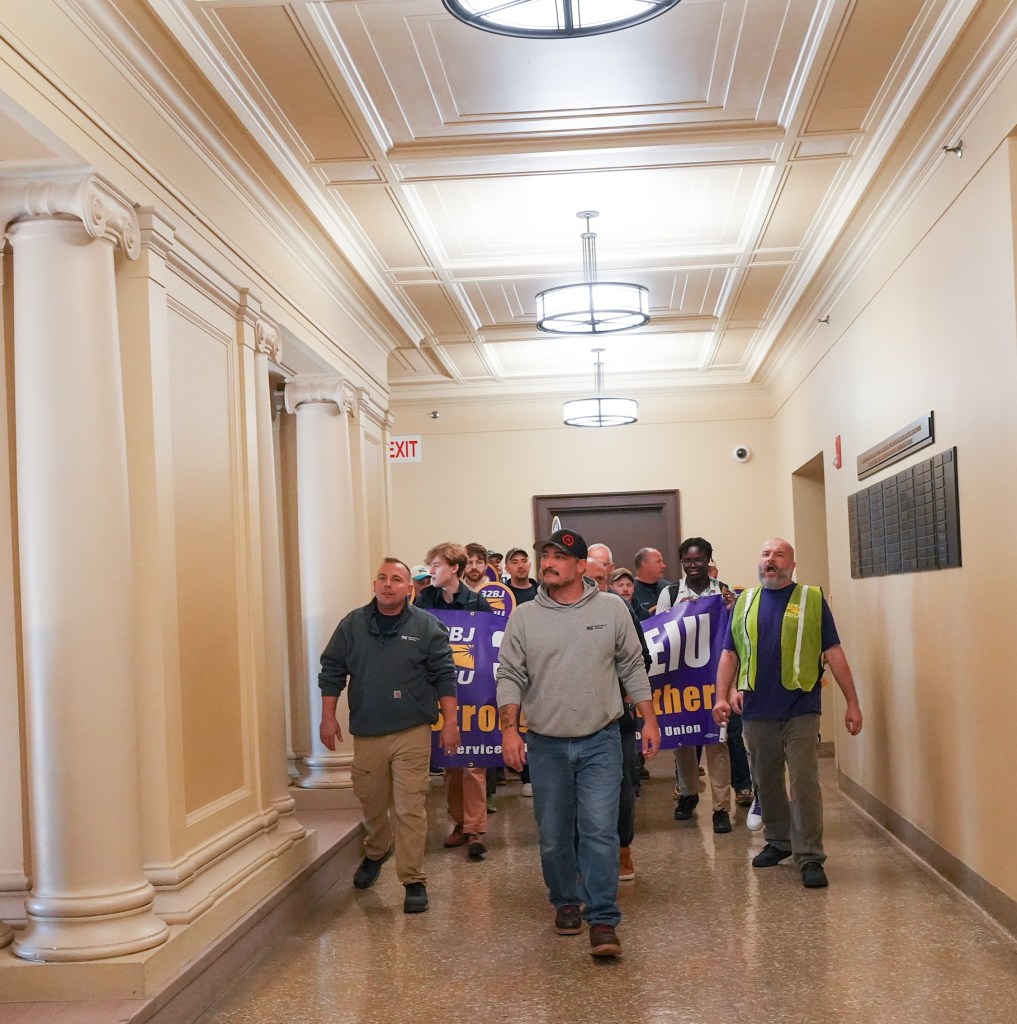
MIT has increased staff health insurance premiums by 11% and proposed increasing SHIP (Student Health Insurance Plan) deductibles and co-pays. Because MIT GSU bargains the terms of SHIPs that apply to all graduate and undergraduate students, not just those MIT recognizes in the union, they see these negotiations as particularly important.
International workers make up nearly half of each union’s membership. 32BJ is seeking to strengthen existing language protecting their local’s international workers, while MIT GSU is seeking new contract language with protections for their workers.
Because of this alignment on core issues, the two unions have been able to collaborate: submitting joint resolutions, standing together on issues in bargaining, and sitting in on each other’s bargaining sessions.
There’s something else they have in common: the lack of respect with which university administration treats them. When 32BJ members first sat in on grads’ bargaining sessions, they were shocked by the administration’s rudeness. “The way they talked to them was ridiculous… I couldn’t believe it. The way that they talked to these grads, the way they treated them, the offers they made – it was really eye-opening,” said Jim Bradford.
Moving forward together
MIT claims not to have the money to pay their workers a living wage, something the facts contradict.
MIT has a $29.2 billion endowment, which grew by nearly $3 billion in fiscal year (FY) 2025 and almost $2 billion in FY 2026. MIT’s president, Sally Kornbluth, reportedly made over $2 million last year. At the same time, MIT spent millions on campus surveillance cameras and $217.6 million on capital (land, buildings, and equipment) projects. MIT holds a AAA credit rating, meaning that they are able to take on debt on relatively favorable terms, something they often do for construction projects using their $500 million annual line of credit.
Both unions are demanding higher wages. MIT says they can’t afford it. As we’re all profoundly aware, the cost of living is rising. Any raises below inflation are effectively a wage cut.
“They’re putting buildings up everywhere,” said MIT GSU president Lauren Chua. “They have lots more revenue streams coming through in this age of AI, they have so much they’re trying to profit off of. And we’re going to go into our contract negotiations just asking for some bare minimums of fair pay and fair compensation for the work that keeps this institute running.”
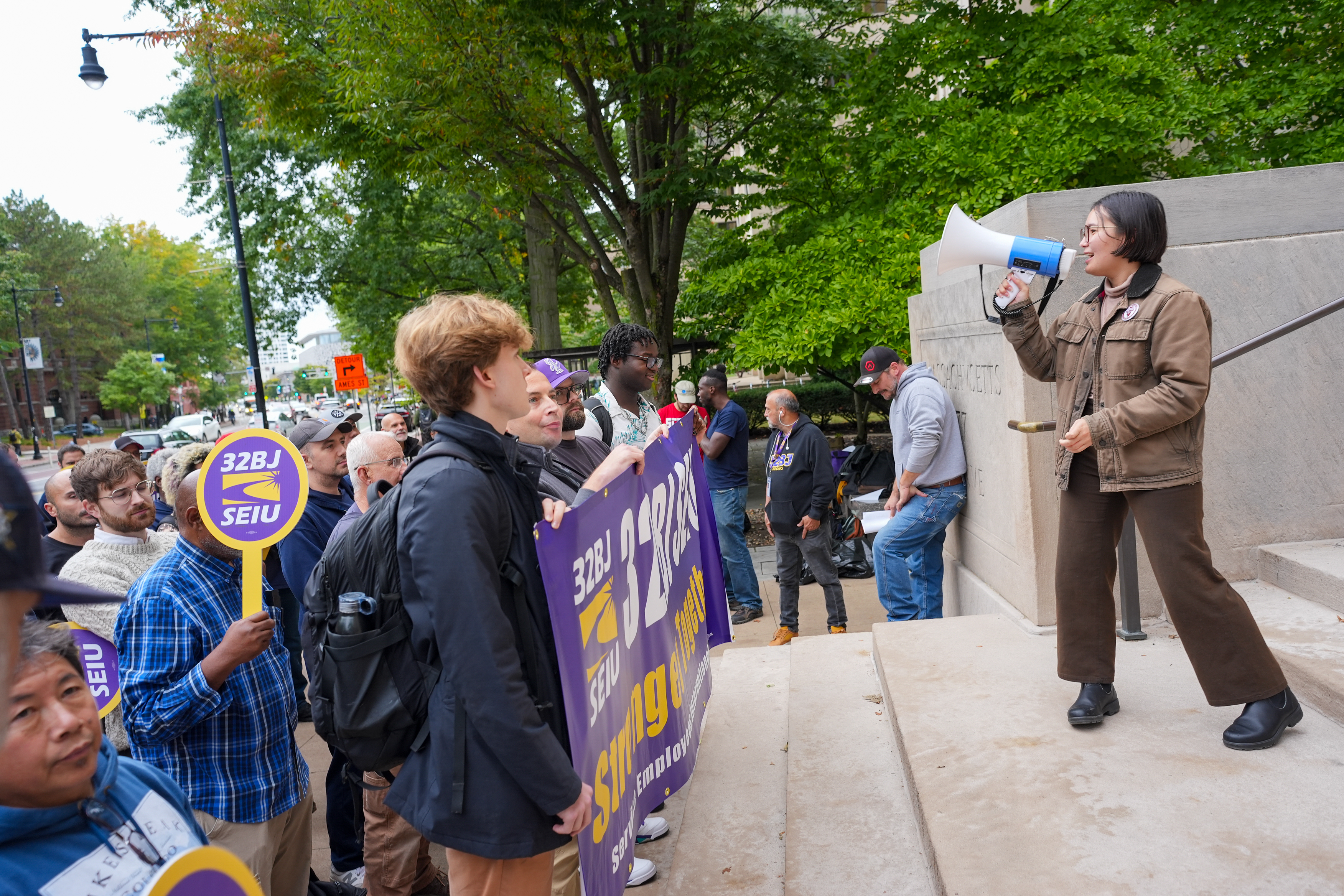
As they move together towards strike action, 32BJ and MIT GSU are asking for solidarity from colleagues and community. Faculty and staff are being called upon to demonstrate a united front with blue-collar workers and grad students. Union members at other Boston-area institutions like Tufts and Harvard are showing up for MIT workers’ rallies and practice pickets. Teamsters Local 25 – whose members work not only as delivery drivers for UPS, but also deliver a variety of other crucial materials to campus to support its operations – has pledged to respect a strike and stand with MIT workers if the time comes.
“It’s inspiring to see such powerful collaboration happening at MIT,” said HELU Chair Levin Kim. “This is the kind of work HELU is looking to lift up, support, and help recreate across the country.”
Chua put it succinctly: “We have each others’ backs.”
A Call to Action
Both unions call on HELU members and allies to email MIT President Sally Kornbluth, Provost Chandrakasan, and Chancellor Melissa Nobles to call on the MIT administration to agree to fair contracts now, before 32BJ and MIT GSU are forced to strike. Their email addresses are: president@mit.edu, provost-reply@mit.edu, and chancellor@mit.edu.
Hear more from MIT student @rstephen.04: