by Brendan McGovern
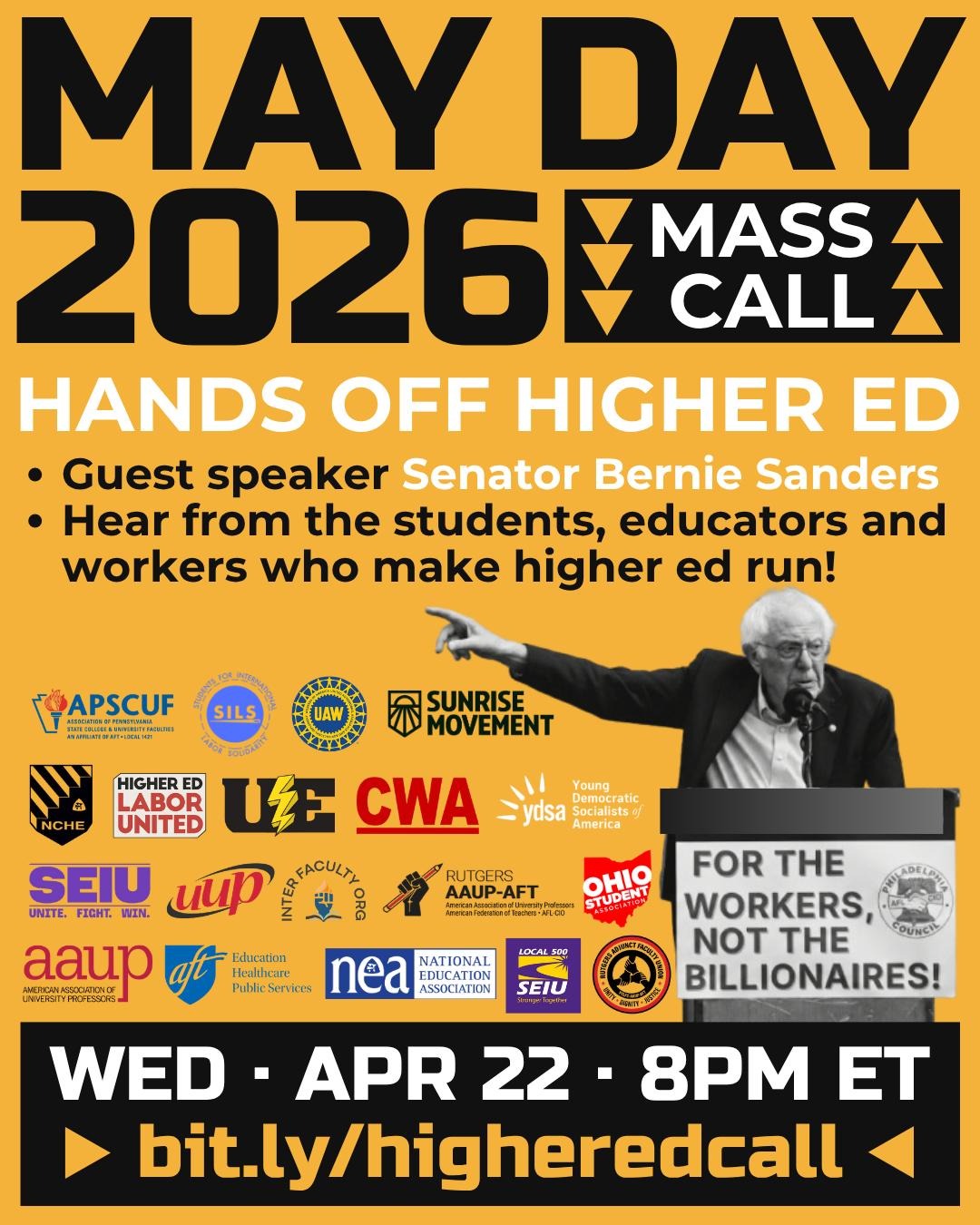
May Day, observed each year on May 1, is one of the most important days in the global labor movement. Its origins trace back to the struggle for the eight-hour workday in the late 19th century, when hundreds of thousands of workers across the United States went on strike in 1886 demanding basic dignity on the job.
|
by Ian Gavigan
HELU’s vision of higher ed organized wall-to-wall and coast-to-coast rests upon the idea that union locals are the starting point for an organizing strategy that builds power at the sectoral level in order to wage a national fight against our broken system of higher ed finance and governance.
|
by Jenna Chernega
As Thomas Gokey mentions in his piece, we have three main projects running right now. They are the White Paper, the Candidate Questionnaire, and the work on College for All. Here is some background on each of these.
|
by Helena Worthen
HELU’s basic idea of centering the hoped-for transformation of the higher ed sector around labor means confronting opposition on multiple levels. One level is obviously collective bargaining, where unions bargain with employers. Another level is the political, specifically legislative level, where workers fight to get collective bargaining laws passed and lobby, educate and influence elected representatives at the state and national level. A third is the level of public consciousness and culture.
|
by Carolyn Kube
HELU organizes local unions and labor organizations, not individual people, although individuals can join. This makes HELU organizing different from organizing people into a local union. The idea behind HELU is that by drawing the local unions at a campus into a coalition that reaches from coast to coast, we can build the kind of power sufficient to force a transformation of our whole higher ed system.
|
Higher Ed Labor in the News
|
Want to support our work? Make a contribution.
|
We invite you to support HELU’s work by making a direct financial contribution. While HELU’s main source of income is solidarity pledges from member organizations, these funds from individuals help us to grow capacity as we work to align the higher ed labor movement.
|
|